
Assembly for Peace Handbook (2024)
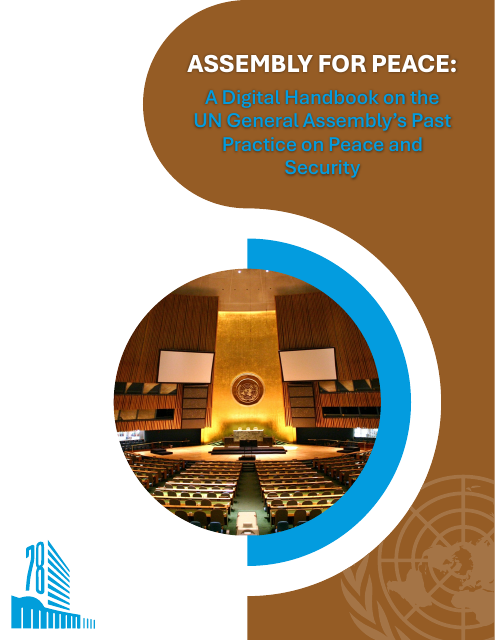
Produced at the request of the General Assembly (resolution 77/335) in its 78th session, this digital handbook summarizes Assembly powers and past practice on peace and security.
Introduction
Although the UN Charter vests primary responsibility for peace and security with the Security Council, it grants the General Assembly broad powers and responsibility to consider any issues within the scope of the Charter, and to make recommendations to both Member States and the Security Council (SC). Drawing on this authority, the General Assembly (GA) has since its founding engaged with a wide range of peace and security matters, deploying mediators to contribute to conflict resolution, mandating the establishment of peace operations or other operational bodies, recommending measures in response to uses of force or sanctions and creating or supporting accountability mechanisms, among other actions. However, much of this practice is relatively unknown, or difficult to access in a user-friendly fashion, leading to limited understanding of the potential courses of action available to the GA.
In its 77th session, the Assembly passed resolution 77/335 (A/RES/77/335), which recognized the need for greater access to information about the Assembly’s functions and powers with regard to peace and security. It requested the President of the General Assembly to provide a digital handbook or other guides on past practices, functions and powers of the GA under the Charter. This Handbook, Assembly for peace: a digital handbook on the UN General Assembly’s past practice on peace and security, was produced by UNU-CPR for the President of the General Assembly in its 78th session in September 2024, and included information on the Charter basis for GA action, summaries and examples of past practice, as well as recommendations on how Member States could foster deeper interaction with the SC.
This digital form of the Assembly for Peace Handbook (2024) reproduces the original content, but updated to include resolutions adopted since the Handbook was published, and with links to additional cases and materials available on this website. Further information on the development of this website and any modifications to the Handbook text and form are available the About section.
How to Use this Digital Handbook
This is an interactive, digital handbook, designed to be user-friendly and easy to access. Certain common terms are abbreviated throughout (including GA and SC), and hyperlinks are provided for all cited resolutions and many other UN documents. The main chapters focused on areas of practice are designed to be reference guides, to be read interactively with a series of case studies. In addition to the original 61 case studies in the Assembly for Peace Handbook (2024), some area of practice summaries also now incorporate additional case studies and information. Information on when material was last updated and developed is available with the date and notation at the top of each content page.
If you would like to understand key issues and main trends, skim through the Handbook Main Sections and Contents bar and click to the topic you would like to read about. If you want to view all of the areas of practice, beyond those contained in the original Assembly for Peace Handbook, visit the Areas of Practice page. If you would like more detail on cases referenced in the summaries of practice, click on hyperlinks in the main text or go to the Cases of practice library.
Handbook Main Sections and Contents:
Visit other related materials:
Legal Background: UN Charter Basis and Procedural Developments
The Charter of the UN provides the SC with “primary responsibility” for international peace and security (Article 24); however, it also empowers the GA to play a significant role in the maintenance of peace and security. As the International Court of Justice (ICJ) stated in its , the SC’s jurisdiction is “not exclusive … the General Assembly is also to be concerned with international peace and security”.1
Three articles within Chapter IV of the UN Charter grant the GA substantial authority to deliberate and make recommendations with regard to peace and security matters:
- Article 10 authorizes the GA to “discuss any questions or any matters within the scope of the present Charter” and “except as provided in Article 12, … make recommendations to the Members of the United Nations or to the Security Council or to both on any such questions or matters”.
- Article 11(2) empowers the GA to “discuss any questions relating to the maintenance of international peace and security” brought before it by a State or by the SC, and “except as provided in Article 12, … make recommendations with regard to any such questions to the state or states concerned or to the Security Council or to both”. Article 11(3) specifically empowers the GA to “call the attention of the Security Council to situations which are likely to endanger international peace and security”.
- Article 14 authorizes the GA to “recommend measures for the peaceful adjustment of any situation … which it deems likely to impair the general welfare or friendly relations among nations”.
These provisions not only enable wide scope for the GA to deliberate on peace and security matters, but also create an additional accountability role for the GA vis-à-vis the SC on matters related to peace and security. Article 11(1) explicitly provides that the GA may make recommendations to the SC with respect to the maintenance of peace and security, and Article 11(3) notes that “the General Assembly may call the attention of the Security Council to situations which are likely to endanger international peace and security”. The GA has frequently relied on these powers to call issues to the SC’s attention, suggest greater attention to a peace and security matter or suggest alternate courses of action.
In addition to these three articles, the Charter sets out other powers and responsibilities for the GA that are relevant to the maintenance of peace, or to crisis response and conflict prevention efforts. Article 13 gives the GA responsibility for making recommendations towards the “realization of human rights and fundamental freedoms”, issues that are implicated in many peace and security crises. The GA is also given certain functional responsibilities, many of which have been relied on to help develop multilateral responses to peace and security situations. This includes the authority to approve the UN’s budget, admitting new members and suspending or limiting the participation of existing members, appointing Member States to non-permanent seats of the SC as well as other key councils and committees, and receiving reports from the SC and the UN Secretary-General. Article 22 of the UN Charter empowers the GA to establish “such subsidiary organs as it deems necessary for the performance of its functions” – an authority that has been relied on to create mechanisms or bodies that can help facilitate crisis management, including establishing peace operations (with the consent of the State whose territory is implicated), commissions of inquiry (COIs), reconciliation committees or other subsidiary bodies.
While the GA’s authority to consider issues of peace and security is very broad, its recommendations are understood as non-binding. The text of the Charter provides that the GA may discuss questions of international peace and security, consider principles of cooperation, and make recommendations for resolving them. However, there is no Charter-based mention of mandatory, coercive powers, which are explicitly given only to the SC and the ICJ in Articles 25 and 94 of the Charter. The distinction that only the SC can engage in binding or mandatory, coercive action is further reinforced in two Charter-based limitations on GA authority. Article 11(2) of the Charter demands that the GA refer to the SC any question “on which action is necessary”. This provision was interpreted by the ICJ in a 1962 advisory opinion as referring to “coercive or enforcement action”, which is exclusively within the powers of the SC.1
While ICJ advisory opinions are not binding, they help to clarify key rights and obligations under international law, including with respect to those laid out in the UN Charter. Several ICJ advisory opinions have considered the scope of the GA’s authority under the Charter, including the Certain Expenses case, a 2004 advisory opinion on the legal consequences of the construction of a wall in the Occupied Palestinian Territory (OPT) (hereinafter ), as well as a 2010 advisory opinion related to the status of Kosovo (hereinafter ).
The interpretation that the GA should refer matters requiring coercive action to the SC does not signify limitations on the scope of what the GA can recommend or consider for discussion, but simply reinforces that the GA recommendations are not binding in themselves. As illustrated in the examples of practice covered in part II, GA resolutions have covered a wide range of peace and security issues, including recommendations related to the use of force, imposition of sanctions or other measures that would require coercive authority to have a mandatory effect. In some instances, the GA has accompanied these recommendations with calls for the SC to take appropriate Chapter VII action.
The second restriction relates to Article 12(1), which prohibits the GA from making a recommendation regarding a situation where the SC “is exercising … the functions assigned to it”. In early practice, this provision was interpreted to mean that the GA was prohibited from making recommendations on any matter on the SC’s agenda. Indeed, in some early cases the SC removed items from its agenda in order to enable the GA to take action on it. However, interpretation of Article 12’s limitations has evolved over the course of practice to make this less strict a bar. In the ICJ’s 2004 Wall case, the Court observed “an increasing tendency over time” for the GA and the SC to consider matters in parallel, so much so that it might now be considered “accepted practice” and consistent with the UN Charter for the GA to take up matters still under consideration with the SC. Throughout all of the practice sections in part II, most of the matters that were the subject of GA resolutions were being considered in parallel with the SC, very often generating complementarity in action that contributed to crisis management or conflict resolution.
Developments in Procedures and Practice
These Charter-based authorities are the powers that the GA relies upon in any engagement with peace and security matters, regardless of the procedural basis for deliberation or for adoption of a resolution. In 1950, the GA adopted a resolution known as the “Uniting for Peace” (UFP) resolution, which created a special procedure to facilitate prompt (within 24 hours) GA consideration when there is a veto or threat of veto in the SC over a peace and security matter. The UFP does not create any additional powers; any GA resolutions adopted in emergency special sessions rely on the Charter-based powers outlined above. However, activation of the UFP resolution often provides an additional degree of impetus and political expediency that may facilitate action on ongoing conflict and crisis situations over which the SC is deadlocked. While most of the GA’s engagement with peace and security matters occurs during its regular sessions, some GA resolutions related to peace and security issues have been passed during special sessions or within emergency special sessions reconvened in connection with the UFP resolution from 1950 (A/RES/377(V)).
A final important procedural development to highlight is the so-called Veto Initiative, which was passed as resolution 76/262 on 26 April 2022. Initiated as a way to encourage greater accountability over permanent members’ use of the veto in the SC, it provides that every time a veto is used in the SC, the GA will meet within 10 working days and “hold a debate on the situation as to which the veto was cast” (A/RES/76/262). While the Veto Initiative does not directly trigger GA action beyond the debate about the veto, it constitutes an important evolution in the GA’s practice, and an opportunity to deepen the relationship between the SC and GA on matters of peace and security. This material is compiled into a separate resource on the Veto Initiative, including a table of GA responses to vetoes cast in the SC since the Veto Initiative was put in place, updated to the present.
Explore these procedural developments and the practice in more detail:
Uniting for Peace
Background on the Uniting for Peace resolution and the emergency special sessions associated with it.
The Veto Initiative
Background on the Veto Initiative and the GA debates convened in alignment with it, including a table of all such debates.
Past Practice on Peace and Security: Key Areas and Trends
Over the past 78 years, the GA has acted under its Charter-based authority in a wide range of settings, and offered recommendations covering a range of peace and security responses. This includes recommendations to create or extend peace operations, to cease hostilities, to provide or refrain from providing military support, to impose sanctions, to mandate envoys and mediators, and to undertake other diplomatic actions. In response to some peace and security situations, the GA has played more of an accountability role, offering its determination on whether certain actions constitute violations of international law or the UN Charter, establishing fact-finding missions, COIs or other bodies linked to investigation or adjudication, or referring matters to the ICJ or other judicial bodies. In many situations, the GA has not only recommended some of the above actions, but specifically called the SC’s attention to the matter, noted past SC failure to address the situation, and/or requested that it take further action in response to GA recommendations.
The Assembly for Peace Handbook (2024) summarized five key areas of practice:
Peace operations
Establishing peace operations and other operational bodies, laying foundations for operations, and providing other forms of support.
Responses to use of force
Calling for ceasefires and withdrawal of forces, identifying Charter violations, recommendations on military support and enforcement action.
Sanctions
Recommending the imposition, removal or adjustment of sanctioning measures, and creating sanctions monitoring bodies
Accountability
Identifying violations, establishing investigative bodies, referring matters to judicial bodies and other accountability measures.
Good offices and mediation
Mandating mediators, contact groups, and Secretary-General good offices, using convening power to facilitate negotiations.
Further learning
Explore the full Areas of Practice section for summaries and trends on additional areas developed since the original Handbook.
Each Area of Practice summary discusses general trends in GA practice, including how these related to SC deliberations or decisions on the same matters. There are additional case studies for each practice section, with hyperlinks to the relevant case embedded in the discussions of practice in each section and also available in the Cases of Practice library. Each Area of Practice summary considers resolutions passed both in the context of the UFP resolution and through other procedural routes.
Conclusions
In its resolution 77/335, which requested this digital Handbook, the GA underlined the continued need to foster interaction between the GA and the SC. This survey of the GA’s past practice, detailed in part II, has identified important roles for the GA to play in peace and security matters, as well as several cross-cutting lessons that could contribute to greater complementarity between the GA and the SC.
The key lessons derived are as follows:
1. Charter-based GA authority to act. The UN Charter places few limitations on the GA’s authority to consider matters related to threats to international peace and security, and to offer recommendations to address them. Although the GA is restricted from coercive or enforcement action (the sole preserve of the SC), the Article 14 authorization for the GA to “recommend measures for the peaceful adjustment of any situation” includes actions that can have “force and effect”2 – from authorizing peace operations, fact-finding commissions, panels of experts or other bodies, to making determinations on violations of the Charter or of international law, requesting the use of the Secretary General’s good offices or utilizing the GA’s budgetary authority to support accountability or conflict resolution measures. The breadth of practice described in this Handbook illustrates that the GA has an expansive set of options when considering future responses.
2. Shaping the international response. Even where the GA is not driving a specific response, its actions can play an important role in shaping how others act. GA resolutions calling for peace operations, sanctions, ceasefires or withdrawal of forces, accountability measures, and for direct responses by the SC have often been the cause of important initiatives and binding responses. GA resolutions in support of ongoing processes – including through budgetary support – are often crucial to their success. Particularly in situations where the SC appears less able to act, the GA can function as an important driver of international action.
3. Keeping matters on the agenda. GA action ranging from accountability mechanisms on particular country situations to recommending responses to global threats – for example, on disarmament or climate change – have helped to keep key peace and security matters on the agenda, even when, or especially when, the SC appeared unwilling or unable to act on them.
4. A complementary role in accountability. When faced with large-scale violations of international human rights and humanitarian law, the Human Rights Council (HRC) and SC have the most important accountability functions. But the GA has important and wide-ranging tools and practices that can complement these functions, and in some cases the GA has led accountability initiatives. Identifying how the GA, SC and HRC can operate with even greater complementarity could be further explored.
5. Holding the SC accountable. GA resolutions and action on particular matters have often served a broader accountability role, highlighting the failure of the SC to address the issue or encouraging it to take more concerted action in the future. More recent practice under the Veto Initiative offers a new set of practices to encourage deliberation and accountability in cases where SC responses have been blocked by a permanent member’s veto.
6. Towards GA-SC synergy. The GA’s practice in all areas described above stands for the principle that the GA is able to act while a matter is on the SC’s agenda. In many cases, the GA directly supports or enables SC action, creating a broader basis of international consensus and amplifying the voice of the SC. Rather than see the GA as a competing actor in matters of peace and security, the cases suggest that it could be more helpfully considered a synergistic and complementary one. Identifying forums and opportunities for building towards a greater synergy should continue to be pursued.
Key ICJ advisory opinions clarifying general Assembly powers vis-a-vis the Security Council
(1962)
(2004)
(2010)
Notes
- Certain Expenses of the United Nations (Article 17, Paragraph 2, of the Charter), Advisory Opinion), I.C.J. Reports 1962, p. 151, p. 163. ↩︎
- ICJ, Certain Expenses, pp. 163–164. ↩︎